
Godzilla vs. King Ghidorah 1991: The Pivotal Clash of the Heisei Era
A tactical breakdown of the historic 1991 duel: time-travel paradoxes, Dorats genetic mutation, the genesis of Mecha-King Ghidorah, and Koichi Kawakita's practical SFX mastery.
1. Historical Background & The Time-Travel Paradox

Released in 1991 under the visionary direction of Kazuki Omori and special effects master Koichi Kawakita, Godzilla vs. King Ghidorah was a seismic box-office phenomenon. The film did not merely reset the power dynamics of the entire Heisei era (1984–1995); it boldly injected a high-concept sci-fi narrative anchored in time-travel paradoxes.
The story begins when a futuristic saucer craft designated MOTHER touches down in modern Japan, carrying visitors calling themselves "Futurians" from the 23rd century. They warn that in their timeline, Godzilla will permanently irradiate and annihilate the Japanese archipelago, rendering it a desolate wasteland. They propose an expedition back to 1944 on Lagos Island in the South Pacific—where a surviving prehistoric dinosaur dubbed Godzillasaurus once defended a Japanese garrison during World War II.
Their stated goal is to teleport Godzillasaurus to the desolate Bering Sea before the 1954 American hydrogen bomb detonation at Bikini Atoll (Operation Crossroads / Castle Bravo), thereby erasing Godzilla from history. However, beneath this altruistic veneer lay a ruthless geopolitical conspiracy:
- The Treacherous Swap: Rather than leaving Lagos Island barren, the Futurians secretly deposited three cute, genetically manufactured winged pets known as Dorats.
- Thermonuclear Coalescence: When the 1954 H-bomb detonated, the unimaginable thermonuclear fallout melted and fused the cellular structures of all three Dorats into a single, terrifying three-headed draconic chimera: King Ghidorah.
- The Dual Paradox: Transporting Godzillasaurus to the Bering Sea failed to avert disaster. Decades later, a Soviet nuclear submarine sank in those exact sub-Arctic waters. The resulting radioactive leak mutated the dormant dinosaur into an even more colossal Godzilla—surging from 80 meters to 100 meters tall with exponentially amplified nuclear reserves.
[!NOTE]
"Reimagining King Ghidorah's origin as the radioactive fusion of three innocent Dorats was a drastic conceptual departure from his Showa alien roots. It transformed Ghidorah into a tragic manifestation of human genetic manipulation and hubris." — Director Kazuki Omori.
---
2. Biometrics & Combat Doctrines

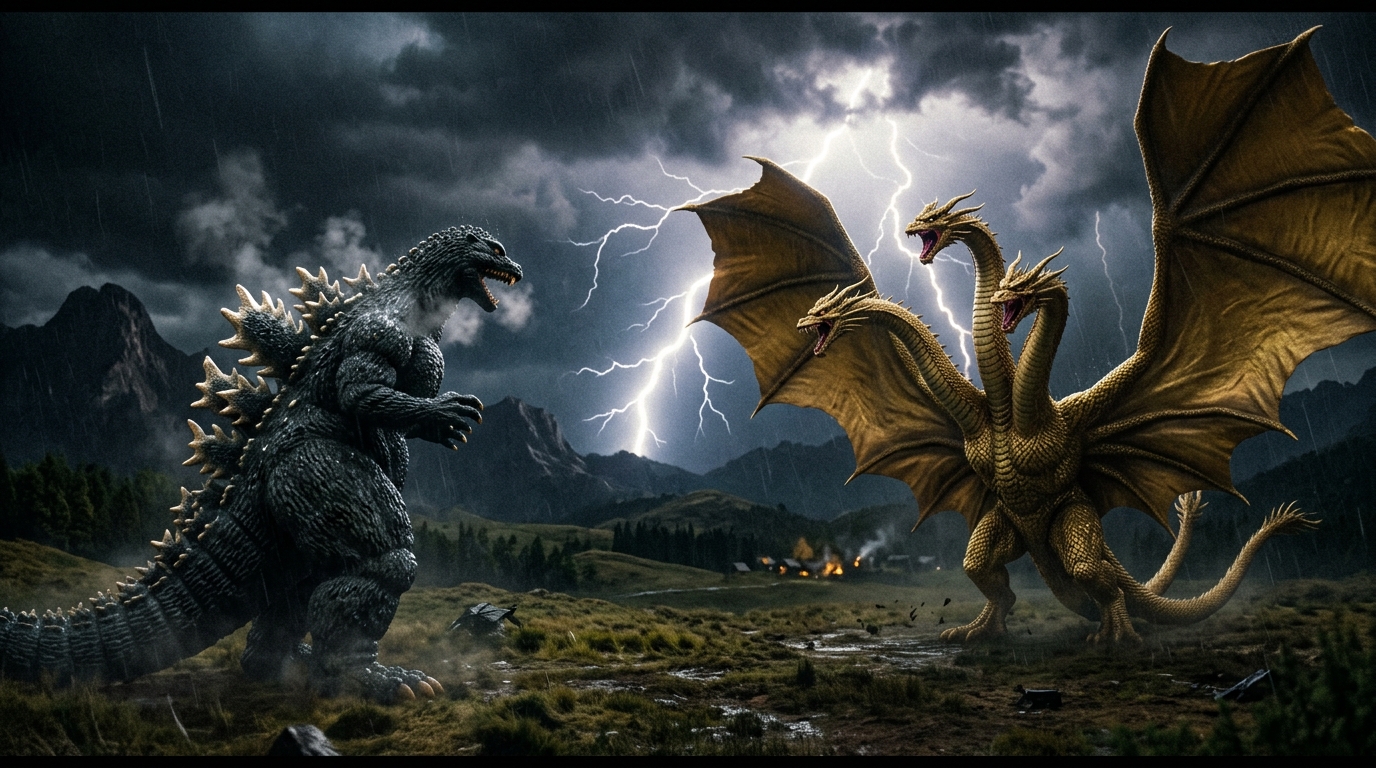
When the 100-meter Godzilla made landfall in Hokkaido and engaged King Ghidorah across the snowbound plains, audiences were treated to an apex clash between two biomechanical titans pushed to the absolute limits of monster cinema:
| Parameter | Godzilla (Heisei Era 1991) | King Ghidorah (Heisei Era 1991) |
|---|---|---|
| Height | 100 meters (a massive 20m increase over the 1984–1989 build) | 140 meters (towering upright presence) |
| Body Mass | 60,000 metric tons | 70,000 metric tons |
| Wingspan | None | 175 meters (durable auric-scaled membranes capable of hurricane winds) |
| Movement Speed | 40 km/h (land) / 40 knots (submerged aquatic cruising) | Mach 3 (atmospheric flight) / Mach 4 (orbital vacuum) |
| Primary Ranged Weapon | Atomic Breath reaching 500,000°C | Triple Gravity Beams discharged simultaneously |
| Signature Melee Attacks | Multi-ton tail whips, crushing jaw bites, kinetic grappling | Serpentine three-neck constriction coils, taloned stomps |
| Regeneration & Defense | G-Cells super-regeneration, deep radiation synthesis | Auric scales deflecting kinetic ordnance, agile flight ceiling |
| Fatal Vulnerability | Vulnerable to sustained aerial bombardment | Brainwave synchronization dependent on Futurian transmitters |
The sheer height disparity (140 meters vs. 100 meters) exerted suffocating visual drama. King Ghidorah's 175-meter wingspan blot out the Hokkaido sky, whipping up gale-force vortexes that overturned Japan Ground Self-Defense Force armor columns and sent Godzilla tumbling onto the frozen tundra.
---
3. The Clash at Hokkaido Plains & The Decisive Nuclear Pulse

The clash across the Hokkaido plains unfolded through four distinct tactical phases:
Phase 1: Aerial Bombardment & Kinetic Dominance
Ghidorah aggressively exploited his flight advantage. Touching down on the plains, all three draconic heads unleashed a synchronized barrage of serpentine, golden Gravity Beams. These beams exerted both extreme thermal energy and gravitational shear, knocking Godzilla backwards repeatedly. Godzilla retaliated with his azure Atomic Breath, but Ghidorah's golden auric scale plating dispersed the thermal impact.
Phase 2: The Constriction Chokehold
Recognizing that beam exchanges were inconclusive, Ghidorah engaged in lethal close-quarters grappling. His muscular, serpentine necks wrapped in tight coils around Godzilla's throat and chest. The multi-ton crushing constriction choked off Godzilla's airway and laryngeal conduits, driving the King of the Monsters to his knees as foam spilled from his jaws.
Phase 3: The Turning Point — The Omnidirectional Nuclear Pulse
Just as Godzilla hovered on the brink of unconsciousness, author Kenichiro Terasawa and Futurian defector Emmy Kano infiltrated the mothership MOTHER, destroying the M-11 computer transmitting the neural control frequency. Stripped of tactical guidance, Ghidorah's three heads succumbed to confusion.
Seizing the initiative, Godzilla compressed the thermonuclear energy from his thoracic reactor and channeled it through his dermal vascular network. A blinding, azure Nuclear Pulse erupted from every square inch of his skin in an omnidirectional 360-degree shockwave. The violent detonation threw all three necks back, scorching Ghidorah's auric scales in clouds of smoke.
Phase 4: Point-Blank Decapitation
Breaking free from the chokehold, Godzilla displayed predatory ferocity. Grabbing Ghidorah by both tails, he slammed the 70,000-ton dragon repeatedly into the frozen earth. Channeling full thermonuclear yield into his throat, Godzilla fired a point-blank Atomic Breath that severed Ghidorah's central head clean off. A secondary discharge sheared through Ghidorah's left wing membrane, sending the dragon plummeting into the icy depths of the Sea of Okhotsk.
---
4. 23rd-Century Cybernetics: The Rebirth of Mecha-King Ghidorah

Godzilla's victory plunged Japan into an even deadlier crisis: with no natural predator remaining, the 100-meter titan marched directly into Tokyo, systematically leveling the capital. In desperation, Emmy Kano piloted the time capsule KID back to the year 2204, marshaling 23rd-century cybernetics to salvage King Ghidorah's preserved corpse from the sub-zero seabed:
- Mechanical Cybernetic Head: Replacing the obliterated biological center head, this gleaming chrome fixture integrated quantum target-acquisition sensors, hardened titanium plating, and a high-energy concentrated Triple Laser Beam.
- Solar Wing Panels: The shredded biological wing membranes were replaced by gold-plated photovoltaic composite panels that continuously harvested solar radiation to recharge internal capacitor banks.
- Armored Torso & Cockpit: A heavily reinforced chest pod insulated against 500,000°C atomic rays contained a dual-seat cockpit, granting human pilots direct manual fly-by-wire control.
- Machine Hand & Capture Cables: Stored within the abdomen was the ultimate suppression weapon: five colossal motorized claw digits deploying high-tensile superconducting cables that discharged a 100-million-volt electrical shock, paralyzing Godzilla's nervous system while suspending him in mid-air.
The climactic rematch over the skyscrapers of Shinjuku (centering around the newly erected Tokyo Metropolitan Government Building) was legendary. Despite suffering catastrophic wing damage from Godzilla's atomic breath, Emmy Kano engaged the Machine Hand, hoisted Godzilla into the stratosphere, and plunged both combatants into the deep ocean trench, rescuing Tokyo from total ruin.
---
5. Koichi Kawakita's Tokusatsu SFX Legacy

Godzilla vs. King Ghidorah (1991) is universally hailed as an absolute high-water mark of practical Tokusatsu Suitmation filmmaking:
- The Wire-Puppeteering Feat: Operating King Ghidorah's three independent serpentine necks, twin tails, and massive wings required an overhead scaffold team of over 30 master puppeteers working in seamless unison. Every neck twist and jaw snap was synchronized to fractions of a second using whistle commands.
- Legendary Suitmation: Veteran performer Kenpachiro Satsuma donned the grueling 65 kg latex Godzilla suit, which featured internal radio-controlled servos for lifelike jaw articulation and furious eye movements.
- Miniature Set Precision: Toho constructed an immaculate 1:25 miniature replica of Shinjuku's high-rise financial district. The combination of practical pyrotechnic explosions, falling tempered-sugar glass, and hand-animated optical beam cel layers earned the film the prestigious Japan Academy Film Prize for Special Effects in 1992.
The 1991 clash remains an indelible cinematic blueprint for Kaiju battles across generations.
Related Canonical Entities
Canonical Kaiju profiles and universes referenced in this editorial
Sources & Bibliography
Official publications, film archives, and canonical guidebooks
- 1Toho Special Effects All Monster Illustrated (1993)Official Primary
Definitive behind-the-scenes and power measurements guide
- 2Heisei Godzilla Chronicle (Kadokawa Shoten)Official Primary
Film development history and design notes