
The Evolution of the Atomic Breath: From 1954 Incandescent Vapor to Spiral Heat Ray
Unraveling the biophysical mechanics, thermal milestones across seven decades, and cultural allegory of cinema's most iconic monster attack.
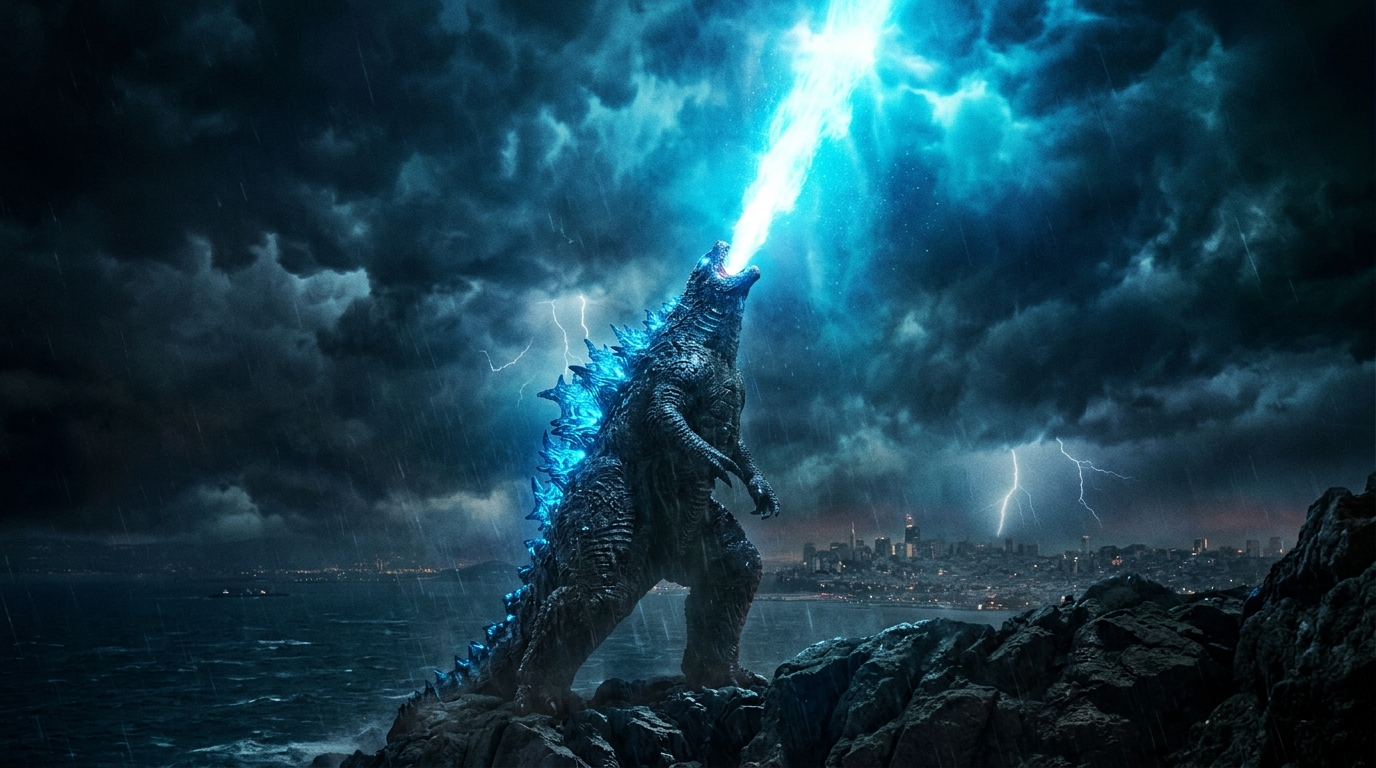
1. Biophysical Mechanics and Anatomy

The Atomic Breath (Radiation Heat Ray) is the quintessential signature weapon of the King of the Monsters, Godzilla. Biologically and physically, this devastating attack is not conventional fire fueled by chemical combustion. It is a focused stream of high-energy ionizing plasma saturated with extreme nuclear radiation and staggering kinetic penetration power.
According to foundational biomechanical blueprints from Toho SFX Mechanics and Monarch scientific files:
- Thoracic Nuclear Sac Organ: Deep within Godzilla's thoracic cavity beneath the cardiac sheath lies a specialized biological reactor. This organ continuously metabolizes, concentrates, and refines radioisotopes (Uranium-235, Plutonium, and primordial radiation absorbed from the Hollow Earth).
- Dorsal Plate Luminescence Cascade: Upon entering an offensive discharge cycle, internal bio-nuclear pressure spikes. This triggers biological Cherenkov radiation, surging upward along the spinal column and igniting the dorsal plates in a sequential cascade from tail tip to neck.
- Laryngeal Magnetic Acceleration: Formidable biological magnetic fields encircle the esophagus and oral cavity, functioning analogously to a linear particle accelerator. They constrain the plasma stream into a tightly collimated beam ejected at hypersonic velocities exceeding Mach 3.
[!NOTE]
"Godzilla's breath was never intended to burn like a mythical dragon's flame; it dissolves matter on a subatomic level, leaving nothing but radioactive ash in its wake." — Special effects director Eiji Tsuburaya.
---
2. Technical Specifications & Caloric Yields Across Eras
The following standardized table charts the variations, temperature outputs, and spectral properties of the Atomic Breath throughout 70 years of cinematic history:
| Era / Film | Canon Designation | Estimated Thermal Output (°C) | Spectral Hue | Physical Properties & Signature Feats |
|---|---|---|---|---|
| 1954 (Gojira) | Incandescent Vapor | 100,000°C | Opaque White / Vaporous | Liquefied steel transmission towers, turned entire Tokyo districts into radioactive infernos |
| Showa (1962–1975) | Radioactive Heat Ray | 100,000°C – 200,000°C | Pale Blue-White | Concussive kinetic beam capable of repelling heavy Kaiju; recoil allowed backward flight in Godzilla vs. Hedorah |
| Heisei (1989–1993) | Atomic Heat Ray | 500,000°C | Deep Cobalt / White Aura | High beam coherence, detonated naval battleships and fortified G-Force bases |
| Heisei (1993) | Super Uranium Spiral Ray | 900,000°C | Crimson with Golden Spirals | Infused with Fire Rodan's dying lifeforce, shattered Super Mechagodzilla's artificial diamond armor |
| Heisei (1995) | Burn Spiral Heat Ray | 1,200,000°C | Blazing Crimson with Lightning | Critical Meltdown threshold, warped ambient space and completely disintegrated Destoroyah |
| Millennium (1999–2004) | Millennium Heat Ray / Hyper Spiral Ray | 500,000°C – 1,000,000°C | Fiery Orange (1999) / Blue Spiral (2004) | Destroyed the incoming asteroid Gorath; blasted Keizer Ghidorah out of Earth's atmosphere into deep space |
| Shin Godzilla (2016) | Focused Thermal Radiation | Subatomic Cleavage Limit | Smoke -> Firestorm -> Purple Laser | Three-phase transition from black smoke to flame and a razor-thin purple laser cutting through skyscrapers |
| MonsterVerse (2014–2021) | Thermonuclear Beam | Millions of Electronvolts | Luminous Cobalt Blue | Extreme kinetic drilling force breached Earth's mantle directly into the Hollow Earth within minutes |
| MonsterVerse Evolved (2024) | Supercharged Thermonuclear Breath | 20x Energy Reserve | Vibrant Magenta / Hot Pink | 20x energy storage boost post-Tiamat absorption, completely overpowered Shimo's absolute zero frostbite |
---
3. Chronological Milestones Across Seven Decades
1954: Incandescent Vapor and Ishiro Honda's Warning

In Ishiro Honda's 1954 cinematic landmark, Godzilla's breath was not conceived as a sharp laser beam, but as a billowing incandescent radioactive vapor (ShodaiGojira Vapor).
Rated at over 100,000°C, this deadly cloud liquefied high-voltage electrical towers like wax and transformed Tokyo's Ginza district into a landscape of smoldering radioactive ruins. It served as a stark, painful allegory for the atomic bombings of Hiroshima and Nagasaki, as well as the 1954 Lucky Dragon No. 5 nuclear fallout tragedy at Bikini Atoll.
Showa Era (1962–1975): The Emergence of the Kinetic Particle Beam

Across the 1960s and 1970s, Godzilla shifted from an agent of nuclear wrath to Earth's steadfast protector. Alongside this tonal evolution came dramatic modifications to the breath weapon:
- The ethereal cloud coalesced into a distinct blue-white particle beam.
- The attack acquired significant kinetic momentum, forcefully blasting rival Kaiju such as King Ghidorah, Gigan, and Mechagodzilla across long distances.
- In Godzilla vs. Hedorah (1971), Godzilla famously tucked his legs, curled his tail, and used the sustained recoil of his atomic breath fired at the ground to fly backward across the sky—one of the most bizarre yet unforgettable moments in cinema history.
Heisei Era: The Spiral Heat Ray and Meltdown

The Heisei Era (1984–1995) remains widely celebrated for intricate, hand-animated optical beam effects under the visual direction of Koichi Kawakita:
- Super Uranium Spiral Ray (900,000°C): Introduced in Godzilla vs. Mechagodzilla II (1993). Fatally wounded, Fire Rodan sacrificed its lifeforce, merging radioactive bio-energy into Godzilla's failing reactor to manifest a crimson beam wrapped in golden energy ribbons, destroying Super Mechagodzilla.
- Burn Spiral Heat Ray (1,200,000°C): In Godzilla vs. Destoroyah (1995), Godzilla suffered an irreversible nuclear meltdown as core temperatures breached 1,180°C. Radiating molten magma from his burning skin, every breath discharge erupted as a 1,200,000°C red beam with orange lightning, disintegrating Destoroyah cell by cell.
Modern Era: Shin Godzilla and MonsterVerse Evolved

In the 21st century, cutting-edge visual effects unlocked unprecedented spectacles:
- Shin Godzilla (2016), helmed by Hideaki Anno, reinvented the firing mechanism entirely. Godzilla's lower jaw splits apart as pitch-black smoke blankets Tokyo, igniting into a sweeping sea of napalm before focusing into a razor-thin purple laser beam capable of cleaving skyscrapers and intercepting B-2 stealth bombers from extreme altitudes.
- MonsterVerse Godzilla (2014–2024): Legendary's titan channels cobalt blue thermonuclear fire with earth-shattering kinetic energy, drilling through thousands of miles of planetary mantle into the Hollow Earth in Godzilla vs. Kong (2021). By Godzilla x Kong: The New Empire (2024), absorbing Titan Tiamat's lair transforms him into Godzilla Evolved, boasting magenta-pink dorsal plates and a 20-fold increase in energy capacity.
---
4. Cultural Allegory and Enduring Legacy

Godzilla's Atomic Breath transcends the realm of fantasy visual effects; it stands as a profound cultural metaphor with enduring significance:
- Phantom of the Atomic Era: Born from genuine postwar trauma regarding nuclear armament, every flash of light upon Godzilla's dorsal fins serves as an eternal warning against unchecked technological hubris.
- Nature's Insuperable Power: In modern storytelling, the beam embodies Mother Nature's retribution. Regardless of human technological supremacy, nature retains absolute authority to restore planetary equilibrium.
- Timeless Cinematic Icon: From the menacing bio-luminescent buildup to the earth-shattering detonation across night skies, the Atomic Breath remains one of the most iconic sounds and images in film history, captivating global audiences across seven decades.
Related Canonical Entities
Canonical Kaiju profiles and universes referenced in this editorial